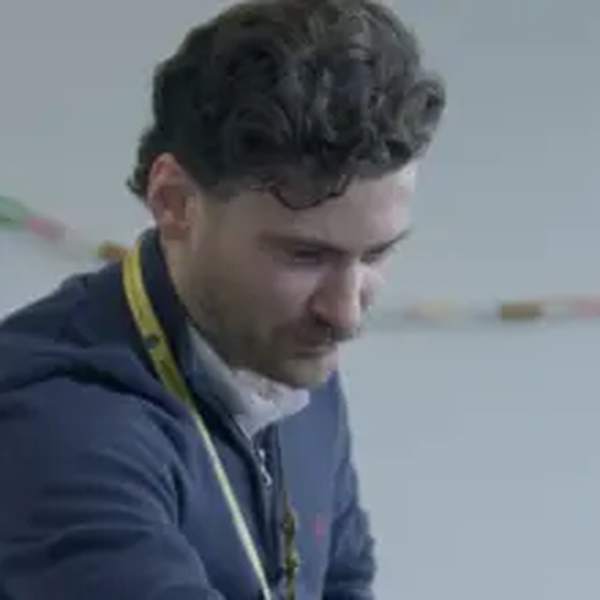
Why this personLeo is a qualified financial adviser who left the industry to teach, and now runs an investing course for beginners. The goblin can show you a ledger. Leo teaches the bit that comes before it: the nerves, the jargon, and the first click on the invest button.
The goblin met Leo years ago in a small village in Nepal, where Leo was teaching and the goblin was doing anthropology research. Now Leo runs Real Life Money in Bristol, and has spent the year sitting people down and walking them through the thing most of them have been putting off. He is a qualified financial adviser, and he is the first to say his sessions are education, not advice.
Dad's graphs

Start at the kitchen table. What did money look like at yours growing up, and where did the bug come from?
Growing up, I was always entrepreneurial and from a very early age had a keen knack for numbers. I distinctly remember my Dad showing me his investments and I was really taken by the graphs and all the stats – plus the idea that your money could grow without you doing anything!
Maths teacher and qualified adviser. Which came first, and what made you go and get the qualification?
When I left university (studying Maths with Business), I only had eyes for the finance industry. But I was adamant that I never wanted to be in a huge corporate machine and sat behind a desk. Financial advice found me through my brother-in-law and on paper it suited me perfectly. Being an IFA would bring together numbers, finance, investing and working with people – all requirements I had for my eventual career.
And while it was finding you?
I got a job to tide me over and this was working in customer service for a small to medium online retailer in Birmingham. I thrived in that environment and my boss really took me under his wing. Every time he got a sniff of me wanting to leave, he gave me more responsibility and more money – essentially trapping me for a few years! By the time I left there, I was Head of Operations and managing customer service, warehouse and the trade counter.
During my time working there, I self-funded and self-studied for the Diploma in Regulated Financial Planning. So by the time I actually joined the industry, I was only a couple of exams away from being qualified.
Why teaching won
The goblin was in that Nepali village doing anthropology while you taught there. Funny how the world now has us both focused on finance. You qualify as an IFA, then walk out to teach. Was teaching always the plan?
Even before I taught in Nepal, I knew that teaching would always be on my radar. I was someone who really enjoyed school and generally got on with my teachers, so I think that it always appealed to me as a career. It hadn't become a concrete plan because I heard so many negative things about the workload and knew there was a certain earnings ceiling.
Then when I met my now wife, she told me she's a teacher and absolutely loves her role. She spoke so highly of it and it brought back all the thoughts of one day becoming a teacher. So when the finance sector had sufficiently put me off, there was only one industry I was heading in to.
My experience of teaching in Nepal had also been really eye-opening. The feeling of working hard for the students' respect and thriving on the satisfaction of seeing them progress stood out and stayed with me.
The fear and the jargon
Your line is "from complete beginner to clicking invest". So what actually stops people clicking? Fear, jargon, or not knowing which button to press?
I think it is often a combination of all 3. The fear comes from the not knowing. And I feel like the finance industry almost deliberately makes things appear complicated so that financial services remain in demand.
People are scared of losing money, and they don't know enough about any of it to manage that risk of losing money. The jargon is a barrier to those aspects being fixed. So what I try to do is cut through the noise and teach people only the factors they need to know and in layman's terms. I want people to come away with the confidence and knowledge to click that invest button. Actually clicking it is the easiest part!
You don't need to be rich
What's the most common wrong belief people bring to your first session?
There are two things that always crop up – one is that investing is inaccessible to them. People often think they need to be wealthy in order to invest, otherwise it's not worth it. I use real-life data and figures to demonstrate that starting with a small amount is absolutely fine, and in the long-term that small amount can grow to something significant!
The second is when we come to learning about bonds. Most people only know about premium bonds. It is a shame, because bonds are a very useful vehicle for managing risk and balancing out a portfolio. But without the knowledge, investors won't choose to use them!
Six years in one session
Which game in the workshop makes the penny drop, and how does it work?
The game that we play in the first session is an investing simulation. There are 6 years of real-life data and players need to choose their portfolio make-up for each of the 6 years. They can choose between cash, bonds, equities and commodities (after we have learned all about them) and then they see how they got on each year and who comes out on top at the end!
This is fantastic way of cementing the theory we have just learned about those asset classes, as they can see their characteristics in front of their eyes. It also allows the players to understand their feelings when a year goes well or not so well – and that introduces the idea of attitude to risk.
So they've felt a bad year. How do you measure someone's appetite for risk? Walk the goblin through it as if he's sitting in the room.
My attendees start to get an idea of their appetite for risk. After that, they use a questionnaire which is from Vanguard. 11 questions answered on their phone and it tells them a recommended portfolio in terms of bonds % and equities %. We then discuss at length the various factors that could affect this, for example the length of time they are investing for.
The expensive one
If you were starting over with your own money, what would you do differently?
I would think more long-term. At age 20 I made the classic mistake of investing my entire pot into one small(ish) company hoping for huge returns and ended up losing around 30%. This is one key lesson I teach my attendees – have a long-term view and spread your risk!
In their wordsIt's a world that has benefited the few and failed the many – and I want to change that whilst having fun.
Leo Dennis · Real Life Money Free money nobody mentions
ISAs and pensions: what's the one move the under-40s most often leave on the table?
One of the most shocking moments from my course is telling people that if they make pension contributions with their savings then the government tops it up. I have had attendees be quite frustrated that this isn't well documented because it is free money waiting for them that they didn't know about.
The goblin checked, because it sounds too good. It's real. Pay into a personal pension and your provider claims tax relief from the government at the basic rate of 20% and adds it to your pot, so £80 from you lands as £100. That's the basic rate for 2026/27; higher-rate taxpayers claim the extra through their tax return, and there are limits on how much gets relief. The source is gov.uk: Pension tax relief.
The catch is that the young have the least spare money, and it's exactly when investing does the most work. How do you get someone started when money is tight?
I just show them that even a small amount invested each month can grow to something significant over the long-term. Little and often is great, and if you don't save anything one month don't beat yourself up – life is also there to be enjoyed!
£100 a month
Someone has £100 and a free Saturday. What do you tell them, the way you'd say it to a mate?
£100 is a fantastic starting point. Did you know that £100 invested per month can grow to around 80-100k in 30 years? Little but often. I would tell them to take an attitude to risk questionnaire, explore the various global index funds and global funds and just click that invest button.
The goblin ran the sum. £100 a month for 30 years is £36,000 paid in. To finish at £80,000 that money has to grow by about 4.9% a year after fees, every year; to reach £100,000, about 6.1%. That's what Leo's range assumes. It is an illustration, not a promise: some thirty-year stretches do better, some do worse, and nobody gets to pick theirs in advance.
Education, not advice
There's no one right way to invest. The goblin leans on dividends because he's self-employed and likes a steady income, and he knows that isn't right for most people. How do you help someone work out what fits their own life?
The challenge comes in the distinction between financial education and financial advice. Although I'm a qualified financial advisor, my sessions do not constitute financial advice and this means I can't tell people specific things they should do or make specific investment recommendations.
One way I deal with this is by showing a number of scenarios and explain what would be best for these hypothetical people – then my attendees can see which one relates to them and make a decision from there.
Ethical investing
Ethical investing: what does it cost in returns, if anything, and how do you tell the real thing from greenwashing?
I try to take the returns side of things out of the equation when talking about ethical investing. Some have done better than standard investments, and some have done worse. But the key fact is feeling confident that your hard earned money is going towards a better future for everyone.
My advice is don't take words at face value – do your research into ethical investments before you commit. I also give three examples of ethical funds at varying exclusion levels so they have something tangible to take away.
Leo reads the hoard
The goblin's hoard is mostly UK income funds plus one big insurer, and he's working towards a freedom number where the dividends cover his living costs. Where does he land on your scale, and what would you warn him about?
So in terms of your portfolio in regards to asset classes (types of investment), you are 100% equities. This would be considered high-risk – but the good thing is you are mostly invested in funds so that does spread your risk somewhat. I steer attendees away from individual stocks and show various examples from history that show the volatility of single companies.
For you, I would want you to be aware that investing in all equities could come with some very volatile times (I'm sure you know this already) and therefore make sure you have a long-term view. I would say 5 years at an absolute minimum but with all equities I would want 10 years plus. The income from the dividends is separate and as long as you don't let your withdrawals eat into your capital then that should be fine.
Fair, and the one footnote is the goblin's own: SMIF, RECI and NCYF are listed funds that hold bonds and loans, so it's all equities on the share register, with a fair bit of credit risk inside the wrappers. The hoard chases payouts because that's the experiment this site runs in public, not because payouts beat growth. For most people starting out, a plain growth fund left alone is the better fit.
Only if you're comfortable: is there a number you'd share? How many people have you helped get started, say?
To date (October 2026), I have helped around 80 people – and that is since February this year. I am extremely ambitious so I'm constantly looking for ways to grow and to help more people. My latest focus is around courses for sixth form and university students. These lucky people have time on their side to let their money grow to life-changing amounts. Many don't realise the opportunity that is at their feet.
The goblin's school was a conveyor belt: GCSEs into A levels into university, and nobody mentioned compounding. Is money finally getting a bigger place in the classroom?
Frustratingly, financial education is still fairly weak in the classroom. There are personal development lessons and these include some money talk but it is fairly theoretical and not that exciting, so students don't show much interest. Also, they aren't taught by subject specialists – so that can lead to misconceptions.
So you're writing your own.
I'm working on a grand plan to teach post-16 students about investing via an adapted version of my course. I will be trialling this at my school and then hope to roll it out wider after that. For young adults, there are lots of concepts that they don't yet understand – like interest rates. That can be a barrier to taking things deeper but I will adapt my course as I need to so that it makes sense for them.
Who should come along
Last one. Who should come on your course, and who shouldn't?
Anyone who feels shut out by the financial world. Many think it is a rich person's game and that simply couldn't be more true. It's a world that has benefited the few and failed the many – and I want to change that whilst having fun. If you wish you knew more, come along. I love to see eager, smiling faces – and I love seeing those light bulb moments when it finally clicks.
What the goblin took away: the button was never the hard part. Six years of real prices in an afternoon, a bad year felt with play money, eleven questions on a phone, and then the click. What the goblin is not copying is the twenty-year-old's move. One small company, the whole pot, about 30% gone. Leo already paid for that lesson so you don't have to.
Thanks, Leo
Thank you, Leo, for the time and for the words. The goblin sent questions and you answered in your own voice, and that is the whole page.
If this made the button feel less like a cliff, Leo is easy to find. He runs Real Life Money in Bristol: a two-evening investing workshop that starts from zero, plus workshops for schools and employers. Start with the workshop page. It is education, not advice, and he will tell you so himself.